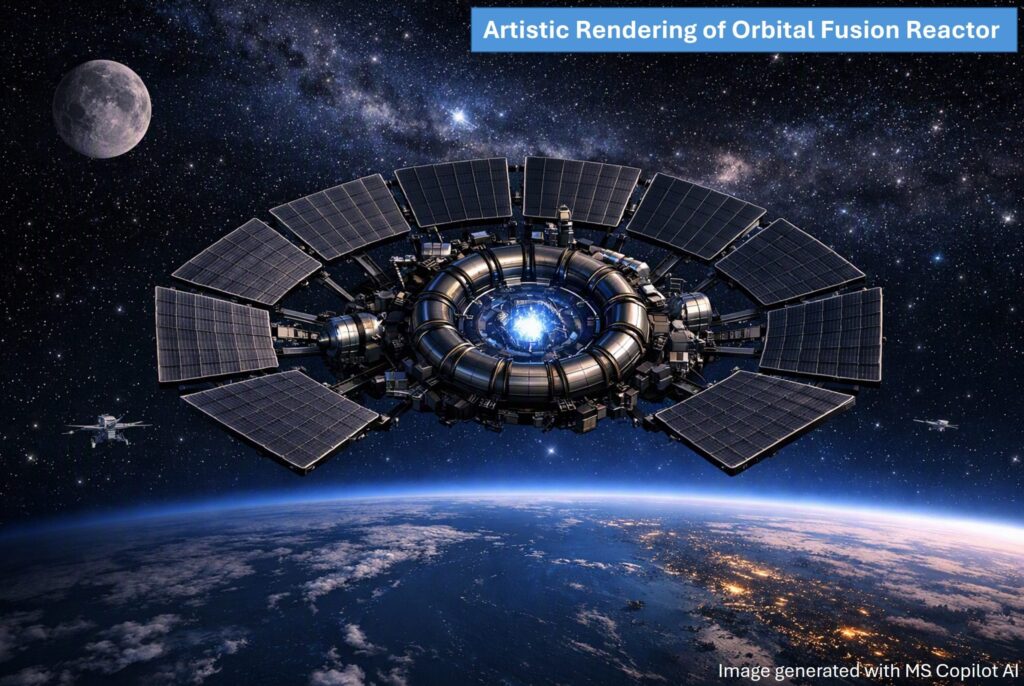
Space-Based Fusion Power

SFuP redefines the design domain for fusion energy by leveraging the unique conditions of space—vacuum, microgravity, and vast volume—to remove terrestrial constraints. These environments enable distributed reactor architectures that trade distance for shielding, temperature for radiator area, and structural mass for high‑specific‑strength load paths.

Our research develops a system‑level framework treating fusion performance, mass, thermal management, radiation protection, structure, and power conversion as a coupled optimization problem. The goal is not a universal performance multiplier, but an expansion of the feasible fusion design space.

SFuP aims to deliver continuous, high‑power energy for space manufacturing, resource utilization, transport, and planetary development. Initially complementing solar and fission systems, its combination of high energy density, longevity, and independence will become vital as space infrastructure scales toward industrial operations.


Hypervelocity Jets

The impact of Hypervelocity Jets at ~100 km/s generates extremely high pressure shocks for investigating astrophysical phenomena and energy efficient x-ray generation for nuclear fusion. We develop devices for generating Hypervelocity Jets to investigate the ways to investigate methods of producing bulk quantities of MIMS.


Explosive-Driven Hypervelocity Jet Generator

Schematic of the demonstrator built in collaboration with the Los Alamos National Lab.

Notes:

PWL = plane wave lens; HE = high explosive PBX-9501; MP = metal piston; CP = cap plate; D = diaphragm; ST = the evacuated shock-tube; PDV = photon Doppler velocimetry probes (2); MI = microwave interferometer.

The confinement was transparent PMMA. The distance between the diaphragm and the left of the cap plate is 190.5 mm.

Simulation of the Hypervelocity Jet Generator


Pictures of a 89-km/s helium jet produced by the Hypervelocity Jet Generator.  If hydrogen was used, the jet velocity would be ~ 110 km/s.


Microwave diagnostic data confirming the velocity of the 89-km/s helium jet (F).